

If you are trying to figure out what career fits you, one of the hardest questions can be this:
What am I actually good at?
Not what you should be good at.
Not what looks impressive on a CV.
Not what other people told you to focus on.
But what comes naturally to you.
A lot of people feel stuck here. They know they want something different, but they do not know what strengths they really have or what kind of work those strengths could point to.
The good news is that you do not always need to start from scratch.
Very often, the clues are already in your past.
Your past jobs, studies, hobbies, responsibilities, and even the things people often come to you for can reveal more than you think.
If you have been wondering what you are good at career-wise, this post will help you spot the patterns and use them as career clues.
Why it can be so hard to see your own strengths
One reason people struggle to identify their strengths is simple:
The things you are naturally good at often feel normal to you.
If something comes easily, you might assume it is not special. You may think:
- everyone can do that
- it is too simple to matter
- it is not a “real” strength
- it does not count because you enjoy it
But that is often exactly where your strengths are hiding.
The things that feel obvious to you may be the very things that are valuable in the right kind of work.
For example:
- maybe you naturally calm people down
- maybe you explain things clearly
- maybe you notice details others miss
- maybe you organize messy situations quickly
- maybe you come up with ideas easily
- maybe you are good at making people feel seen and understood
These strengths matter, even if they do not always have a clear label.
Stop asking “What job should I do?” first
When people feel confused about career direction, they often jump straight to job titles.
They ask:
- Should I become a coach?
- Should I work in HR?
- Should I change fields completely?
- Should I start a business?
But before job titles, it often helps to ask a different question:
What do I seem to do well, naturally, consistently, and with less effort than some other people?
That question gives you something more real to work with.
Job titles can feel overwhelming. Strength patterns are often much clearer.
Look at what people ask you for help with
This is one of the easiest ways to spot strengths.
Think about what people have come to you for over the years.
Do they ask you to:
- organize things
- explain something clearly
- listen and give advice
- write or edit something
- solve problems
- make a plan
- keep things on track
- notice what is missing
- support them when they feel overwhelmed
- make something look or sound better
Sometimes the way other people experience you tells you a lot.
You may not think much of it because it feels natural, but repeated patterns usually mean something.
If people often come to you for the same kind of help, that is not random. It may point to a real strength you could use more intentionally in your work.
Look back at tasks that felt natural in past jobs
You do not need to have loved every past job to learn from it.
Even in roles that were not a good fit overall, there were probably certain tasks that felt easier, lighter, or more satisfying than others.
Think back and ask yourself:
- What parts of the work did I enjoy most?
- What tasks felt natural to me?
- What did I do well without struggling as much?
- What kind of problems did I like solving?
- What was I often trusted with?
Try to focus less on the full role and more on the actual work inside it.
For example, you may have disliked a job overall but still liked:
- writing emails or content
- helping customers
- creating systems
- planning projects
- training people
- improving processes
- researching information
- making things more efficient
- working one-to-one with people
These are valuable clues.
Notice what felt satisfying, not just what you were praised for
Praise can be helpful, but it is not the whole picture.
Sometimes people are praised for things they can do, but do not actually want to keep doing forever.
For example, maybe you were known for being reliable and taking on extra work. That does not automatically mean your ideal career is doing endless admin for other people.
So instead of only asking what you were praised for, also ask:
- What kind of work felt satisfying?
- What kind of work made me feel useful in a good way?
- What kind of work made time go faster?
- What kind of work made me feel more like myself?
This matters because career fit is not only about ability. It is also about energy, interest, and meaning.
Pay attention to patterns across different areas of life
Your strengths do not only show up in paid work.
Sometimes they show up in:
- school or university
- volunteer roles
- hobbies
- side projects
- family responsibilities
- friendships
- community involvement
For example:
- the person who always plans trips, schedules, and details may have strengths in coordination and organization
- the person friends always call when they are upset may have strengths in listening, empathy, and support
- the person who loves improving documents, presentations, or workflows may have strengths in communication and optimization
- the person who enjoys learning deeply and then explaining it simply may have strengths in teaching or content creation
Do not ignore these clues just because they did not happen in a formal job.
They still say something about how you naturally work.
Your strengths may be hiding inside things you take for granted
Many people overlook strengths because they sound too ordinary.
Things like:
- being patient
- making people feel comfortable
- staying calm in pressure
- noticing details
- finding better ways of doing things
- being dependable
- writing clearly
- asking thoughtful questions
- seeing the bigger picture
- breaking complex things into simple steps
But these are exactly the kinds of strengths that can become important career clues.
Not every strength sounds flashy.
Not every strength turns into one obvious job title.
But every strength can tell you something about the kind of work that may suit you.
How to turn your strengths into career clues
Once you start noticing patterns, the next step is to ask:
What kind of work uses these strengths regularly?
For example:
If you are good at listening, understanding people, and asking thoughtful questions
Possible career clues:
- coaching
- client support
- customer success
- HR
- community management
- mentoring
- interviewing
- guidance-based roles
If you are good at organizing, planning, and keeping things moving
Possible career clues:
- project coordination
- operations support
- administration
- event coordination
- online business support
- systems management
- team support roles
If you are good at writing, explaining, and making things clearer
Possible career clues:
- content writing
- copywriting
- editing
- communications
- training materials
- course support
- email marketing
- documentation
If you are good at improving things and spotting what is not working
Possible career clues:
- process improvement
- strategy support
- operations
- customer experience
- business support
- consulting-style roles
- quality or workflow-related work
If you are good at creating ideas and seeing possibilities
Possible career clues:
- content creation
- branding
- creative marketing
- product development
- workshop creation
- teaching
- design direction
- concept development
You do not need to lock yourself into one answer straight away.
The goal here is simply to connect your past clues to possible directions.
Ask yourself these career clarity questions
If you want to go deeper, journal on these:
- What do people naturally trust me with?
- What kinds of tasks feel easier for me than they seem to feel for others?
- What have I done in the past that made me feel capable and useful?
- What kind of problems do I enjoy solving?
- What kind of support do I naturally offer people?
- What kinds of tasks make me feel focused or satisfied?
- What strengths have followed me through different seasons of life?
You do not need perfect answers. You just need enough to start seeing patterns.
Strengths alone are not enough
This part matters.
Even if you are good at something, it does not automatically mean it is the right career path for you.
You also need to consider:
- your personality
- your values
- your interests
- your preferred work style
- your energy
- the kind of environment you want
You may be good at fast-paced people-facing work and still not want a career built around that.
You may be good at supporting others and still want more independence.
That is why career clarity is about more than strengths alone. It is about finding the overlap between what you are good at, what feels right, and what kind of life you want to build.
You probably already know more than you think
If you have been telling yourself, “I have no idea what I’m good at,” that may not be fully true.
It may just mean your strengths have felt too normal, too scattered, or too hard to name clearly.
But the clues are often already there.
In the things people rely on you for.
In the tasks that feel natural.
In the moments you felt engaged, useful, calm, or quietly proud of yourself.
In the patterns that keep repeating.
You do not need to have everything figured out today.
You just need to start paying attention.
Want help turning your strengths into a career direction?
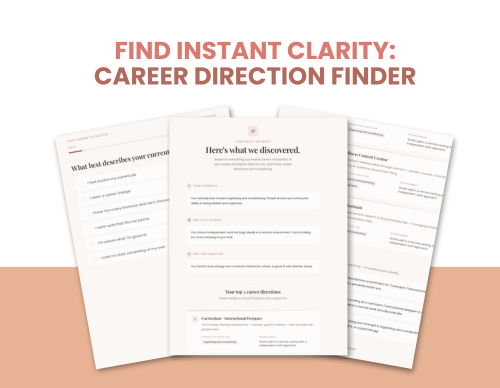
If you want a clearer picture of your strengths and how they connect to real career paths, take my Career Finder Quiz.
It will help you better understand:
- your strengths
- your work style
- your preferences
- and 3 possible career directions that may fit you better
You’ll also get simple next steps so you can move forward with more clarity.

